About us
Antique Samovars of Alexey Vorobyev: From Tavern to Travel
January 30, 2023
By Galina Epifanova
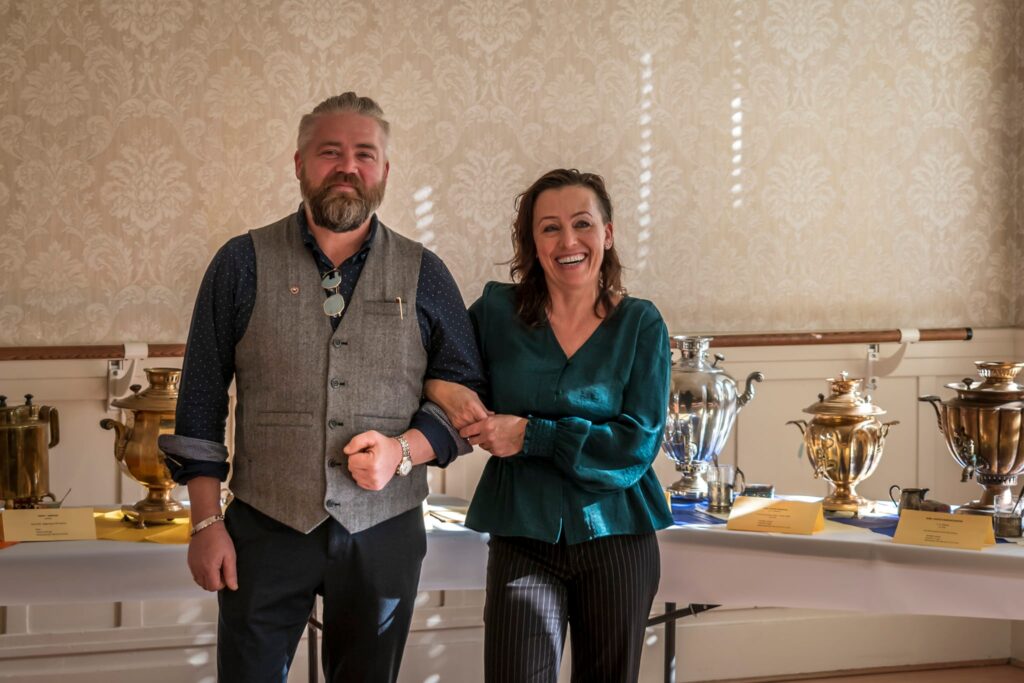
Collector of samovars Alexey Vorobyev with his wife Anna. From the family archive.
Interviewed by Galina Epifanova, volunteer at the Museum of Russian Culture Archive.
Many visitors to the Winter Festival at the Russian Center, dedicated to the memory of Nikolai Massenkoff, were captivated by the rows of gleaming golden samovars lining the walls of the Golden Room. These ornate, round-bodied vessels represented only a small part of Alexei Vorobyov’s remarkable collection, which he began assembling after moving to the United States.
Since the Museum of Russian Culture itself preserves antique samovars, the museum’s staff were especially eager to learn from Alexei about the traditions of Russian samovar-making and the unique challenges of building a private collection in emigration.
Alexey’s passion for samovars began quite by chance. One evening, after dinner at a friend’s house, the host suggested having tea. Expecting a routine tea service, Alexey was surprised when, instead, his friend lit an old family samovar in the backyard — a genuine pre-revolutionary piece brought from Russia. The sight, the process of heating it, and the atmosphere of open-air tea drinking fascinated Alexei. It was deeply heartfelt and unforgettable. That evening inspired him to seek out an antique samovar of his own.
He was also reminded of an old family photograph: his distant ancestors seated around a table with cups neatly arranged, and only the graceful curve of a samovar spout visible at the edge of the frame. Sadly, no samovars had survived in his own family, so Alexei began searching for one to buy. The first purchase was soon followed by a second, and then another — until a solid collection began to take shape, which continues to grow to this day.
When selecting a samovar, Alexey first looks for the uniqueness of its form. Over time, he realized that collecting only the common “barrel-shaped” samovars would be endless and uninspiring, since they were produced in vast numbers. What truly attracts him are distinctive and unusual shapes — and the variety is extraordinary. Beyond the familiar “barrel,” there are forms known as “vase,” “sphere,” “egg,” “fountain,” “pear,” “goblet,” “bowl,” and many others.
As with all objects of design, samovars followed fashion trends, and each shape reflects the aesthetic ideals of a particular era or region. According to Alexey, every form reveals its own character: the round samovar seems friendly and good-natured; the “goblet” form is upright and dashing, like a proud gentleman; while angular or hexagonal samovars appear to have a more “difficult” or even aggressive temperament. Although the samovar is often associated with a masculine character, there are also examples of elegantly feminine design.
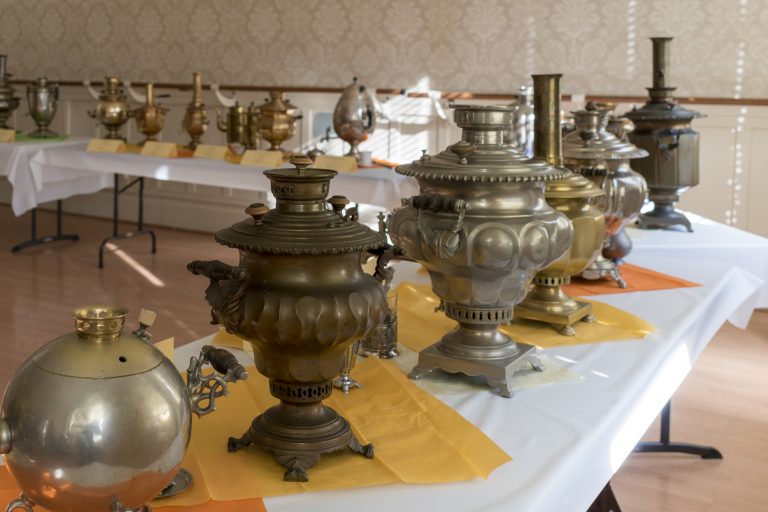
Exhibition of Samovars. Photo by Anna Vorobyeva.
The second key factor for Alexei is the condition and functionality of a samovar. It’s not enough for him simply to own a beautiful object — he wants it to live: to hiss, puff, and fill the air with the aroma of tea. The ability to make tea is essential.
The third criterion in his search is the reputation of the maker. There were many samovar manufacturers in Russia. In addition to the major Tula factories, smaller workshops operated in Vladimir, Vyatka, Kostroma, Mogilev, Moscow, Orel, Perm, Chernigov, the Kingdom of Poland and Warsaw Province, Yaroslavl, and other regions. Yet collectors particularly prize samovars made by the great masters — Batashov, Lisitsyn, Lomov, and Malikov.
As a result, Alexey’s collection includes many remarkable specimens, each with its own story. The first samovar he acquired, in 2008, was made by the factory of Nikita and Konstantin Chernikov, produced in the second half of the 19th century — an elegant “amphora” form. Among the jewels of his collection is a samovar by the famous Tula craftsman Nazar Fyodorovich Lisitsyn. The Lisitsyn family, originally gunsmiths, founded the first samovar factory in the Russian Empire in 1778. It is fair to say that this particular samovar is now approaching its 200th anniversary. It is also the most valuable piece in the collection, being made of tompak — a rich brass alloy once prized for its golden luster, favored by the Russian nobility.
Its story is equally fascinating. The previous owner, a woman from Oregon, left a note with it: her uncle had worked for General Electric, and in the 1960s, while on assignment in Egypt, he — like many of his colleagues — brought home several brass items, including this small Lisitsyn “tête-à-tête” double-draft samovar. It remained in their family ever since. How it reached Egypt remains a mystery — perhaps via Russian merchants or early émigrés.
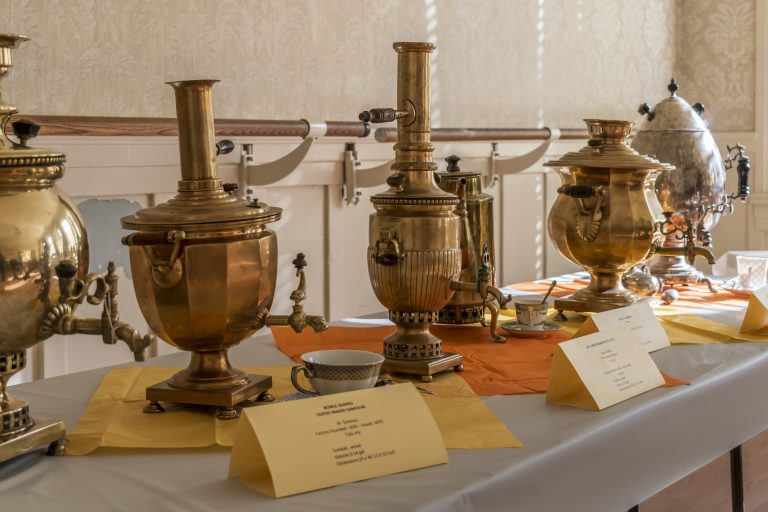
At the center: Lisitsyn factory samovar, “tête-à-tête.” Photo by Anna Vorobyova.
The collection also includes large tavern samovars — for example, one produced by the Shemarin Brothers Factory, one of the most renowned and prolific manufacturers in Tula.
The founder, blacksmith Ivan Shemarin, was born a serf. After gaining his freedom, he moved to the Tula province with his family and began making samovars. In 1906, the factory was granted the title “Supplier to the Court of His Imperial Majesty, the Shah of Persia.”
After the Revolution, in 1918, the factory was nationalized and renamed after V. I. Lenin, continuing production for about fifteen more years, and its samovars were still regarded as among the best in Tula.
In Alexei’s collection, the Shemarin Brothers’ samovar is the largest — about 12 liters — a classic “barrel” form with folding handles.
The collection also features travel samovars, ingeniously designed to be disassembled for use in the field; coffee samovars, meant for brewing coffee; and truly unique, one-of-a-kind pieces — including a whimsical “rooster” samovar.
Alexey’s approach to collecting is deliberate and thoughtful — not random. Every samovar is the result of careful research and a conscious choice, and every one of them is cherished. He actively studies the history of samovars and exchanges knowledge with other collectors in the United States, Russia, and beyond.
Not all samovars in his collection have detailed histories, but nearly all were brought to America by Russian émigrés of various waves. A few exceptions are those purchased abroad by Americans — in Germany or Egypt — and later brought to the U.S. For example, one small Batashov “spider” samovar, capable of being fully disassembled (handles, legs, and spout unscrew, leaving a compact round “ball”), was brought from Germany and likely used for picnics. Another, made by Malikov’s factory, came from Persia.
Of course, in Russia there exist collections numbering in the hundreds, but building such a collection in the Russian diaspora requires special dedication and inspiration. This exhibition was Alexey’s first — and, we hope, the beginning of a long and rich exhibition career.
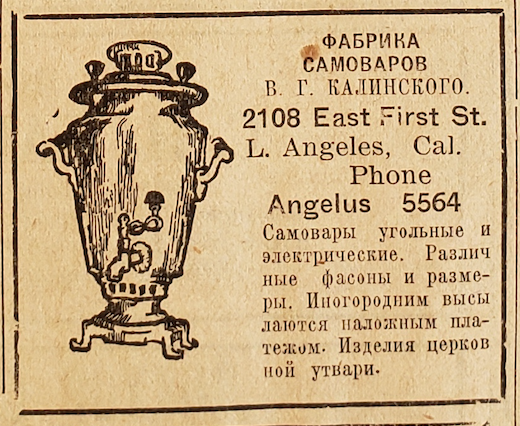
Advertisement of the Samovar Factory of V. G. Kalininsky. Newspaper “Russian Life.”
The very existence of private collections like Alexey Vorobyev’s reminds us of the special meaning samovars have always held for Russian émigrés. Each samovar carries a warm memory of home — a way to preserve family traditions and the familiar rituals of hospitality in a new country. Despite their weight and fragility, many emigrants refused to part with their samovars, taking these family heirlooms along on their journeys.
Interestingly, samovars could also be purchased right here in California. In several 1920s issues of the newspaper “Russkaya Zhizn” (Russian Life), one finds advertisements for coal-fired and electric samovars of various designs, produced by the V. G. Kalininsky Factory in Los Angeles.